Real wargaming
Games that are rehearsals for decisions
A wargame does not predict the future. Done properly, it is a research method that exposes assumptions, tests plans against a thinking opponent and prepares the people who will decide for real.
01 · Definition
What a wargame is
A wargame is a model of conflict in which people make decisions, an opponent responds, and the consequences shape the next round of decisions. That loop of choice and consequence separates a wargame from a simulation, a tabletop briefing or a staff exercise.
Its value is in what it reveals about the problem: hidden assumptions, friction points, options nobody had considered and the reasoning of the people who will have to decide for real.
“A scenario-based warfare model in which the outcome and sequence of events affect, and are affected by, the decisions made by the players.” UK MOD, Wargaming Handbook (DCDC, 2017)
Players who decide. Real people under time pressure and uncertainty, not scripted actors.
An opponent who adapts. A red cell trying to win exposes weaknesses a plan review will miss.
An adjudicator. White cell control decides outcomes using rules, data and expert judgement.
02 · Lineage
Two hundred years of practice
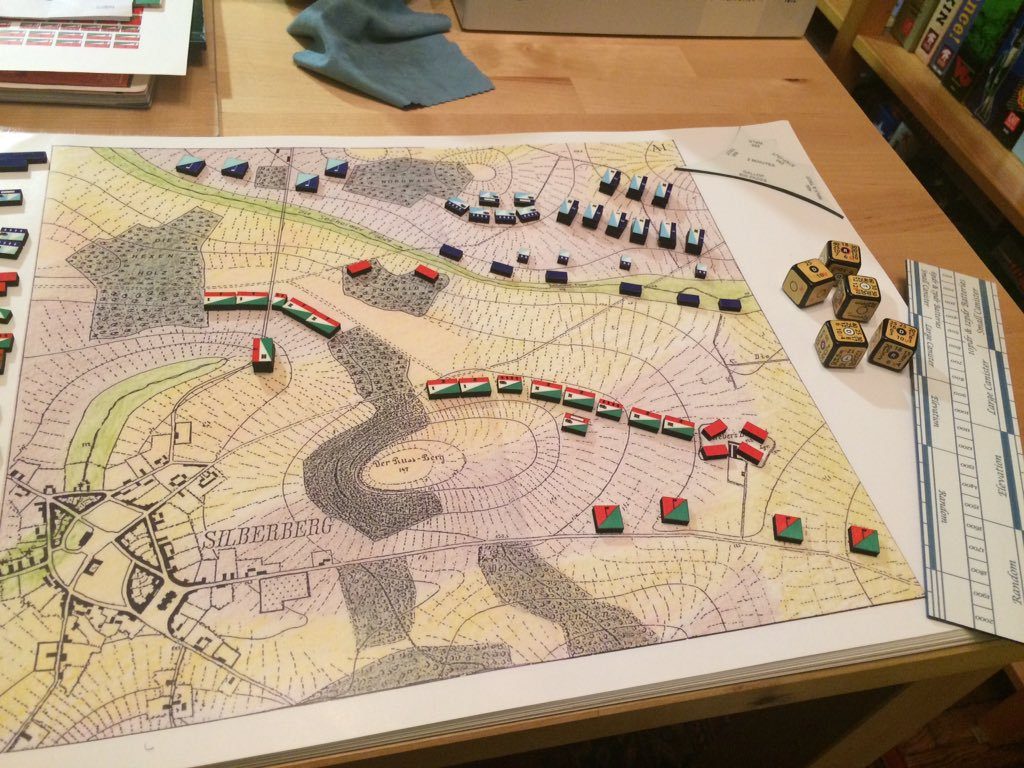
From Prussian staff officers moving blocks on map sheets, to Wrens in Liverpool beating the U-boats, to today's MOD handbooks, the method has been refined over two centuries.
- 1824
Kriegsspiel
Prussian officer Georg von Reisswitz publishes rules for playing war on real map sheets, with an umpire and dice-based results tables. Prussian success in 1866 and 1870 makes armies across Europe take notice.
- 1872
The British Army adopts the war-game
The War Office publishes "Rules for the Conduct of the War-Game", translated from the Prussian rules, bringing staff wargaming into British officer training.
- 1942
Western Approaches Tactical Unit
In Liverpool, Captain Gilbert Roberts RN and a team of Wrens wargame the Battle of the Atlantic. Their tabletop games develop new anti-U-boat tactics that are taught to escort commanders across the fleet.
- 2001
Dstl
The Defence Science and Technology Laboratory is formed. Wargaming becomes a core part of its analysis for the Ministry of Defence.
- 2017
UK Defence Wargaming Handbook
The Development, Concepts and Doctrine Centre (DCDC) publishes practical guidance on purpose, design, adjudication and analysis, alongside its Red Teaming Handbook.
- 2020s
A wargaming revival
UK Defence and NATO expand wargaming for planning, capability development and professional military education. NATO publishes its own Wargaming Handbook in 2023.
03 · Purpose drives design
Two families of game
Training & education
Build the people
The players are the subject. The game develops judgement, teamwork and familiarity with procedures before they are needed.
- Success is measured in learning
- Scenarios can be repeated and varied
- Debrief matters more than outcome
Analytical
Answer a question
The problem is the subject. The game generates evidence about a plan, a concept or a capability for a sponsor who must decide something.
- Success is measured in insight
- Needs a data collection plan from the start
- Findings are traced back to evidence
Expert umpires judge outcomes. Fast and flexible, but only as good as the umpires.
Fixed rules and tables decide results. Transparent and repeatable, but slow and brittle.
Rules set the baseline and umpires may adjust with stated reasons. The common middle ground.
Players argue for outcomes and the facilitator weighs the arguments. Good for political and multi-actor problems.
04 · Analytical rigour
What makes a game evidence
- Frame the question
Agree with the sponsor what decision the game supports. A vague aim produces vague findings.
- Design to the question
Choose scale, time step, adjudication and player roles to fit the problem. Model only what matters to it.
- Plan the data
Decide before play what will be recorded, by whom and how it links to the question: decision logs, rationales, timings, observer notes.
- Play with a free red cell
Give the opponent real freedom to win. Record adjudication decisions and their reasons.
- Debrief and analyse
Run a structured hot wash, then analyse the record. Separate what happened from why it happened.
- Triangulate and iterate
Test insights with modelling, exercises and further games. Peter Perla calls this the cycle of research.
Common failures
How games mislead
Scripting the result
If the plan cannot fail in the game, the game only confirms what the sponsor already believed.
One play, big claims
A single run is one story out of many. Treat it as a source of hypotheses, not a measured result.
Fun over fidelity
Engaging mechanics help, but anything that rewards behaviour the real world would punish teaches the wrong lesson.
05 · Further reading
Sources and standards
- Wargaming Handbook — UK Ministry of Defence, Development, Concepts and Doctrine Centre2017
- Red Teaming Handbook — UK Ministry of Defence, DCDC3rd ed. 2021
- NATO Wargaming Handbook — NATO Allied Command Transformation2023
- Connections UK — the UK's professional wargaming conference and archiveAnnual
- Defence Science and Technology Laboratory (Dstl) — wargaming and analysis for UK DefenceSince 2001
- The Art of Wargaming — Peter P. Perla1990
Stay informed
Get NEXUS updates
Playtest dates, development news and first notice when the boxed edition is available. No spam, unsubscribe any time.